- How Modular Construction Helps Community Colleges Grow and Evolve
- 1. Faster Speed-to-Occupancy
- 2. Flexible Space at a Lower Cost
- 3. Healthy, Sustainable Design
- Using Modular Design to Help Students Succeed and Thrive
- Creating Student-Centered Spaces to Engage and Support
- Creating Specialty Spaces Customed to Need
- Modular Innovation: Creating the Ideal Design for a Unique Project
- Modular Building Solutions Help Community Colleges Succeed
Student-Centered Modular Design for Community Colleges

Community colleges are looking to modernize facilities to meet the evolving needs of today’s students. And they’re looking no further than modular construction—a faster, more affordable way to build specialized spaces to help students succeed.
Community colleges have always offered an affordable alternative to four-year universities, providing technical education, vocational training and local workforce development in addition to a traditional curriculum.
But the workforce is changing. New career pathways are emerging, and expectations are shifting. Students want more out of higher education. They’re looking beyond lecture halls, textbooks and computer screens to innovative spaces and amenities that provide a more robust college experience.
They want modern environments that support many kinds of learning and comfortable spaces where they can relax and socialize. They want on-campus services that help them balance work, life and school and resources that advance their personal and professional growth. They want to feel safe in healthy buildings that make a positive impact on the environment and their local community.
As students redefine what they want from the college experience, community college districts are rethinking what they can offer. They’re reshaping campuses to provide what today’s students want and thinking ahead to anticipate what future students might need.
How Modular Construction Helps Community Colleges Grow and Evolve
It’s not enough to expand programming and add services—community colleges have to create the physical infrastructure to support these new resources. They need new facilities, and they need to get them up and running as quickly as possible.
More and more community colleges are turning to modular design to close the gap between the spaces they have and the spaces they need.
With modular, community college districts can fast-track modernization to offer new career tracks, build resource centers to promote academic success and increase student services to support a wider range of needs.
Higher education is evolving and campuses need to evolve with it. Here are three ways modular construction can help community colleges grow and evolve.
- Faster Speed-to-Occupancy
- Flexible Space at a Lower Cost
- Healthy, Sustainable Design
Faster Speed-to-Occupancy
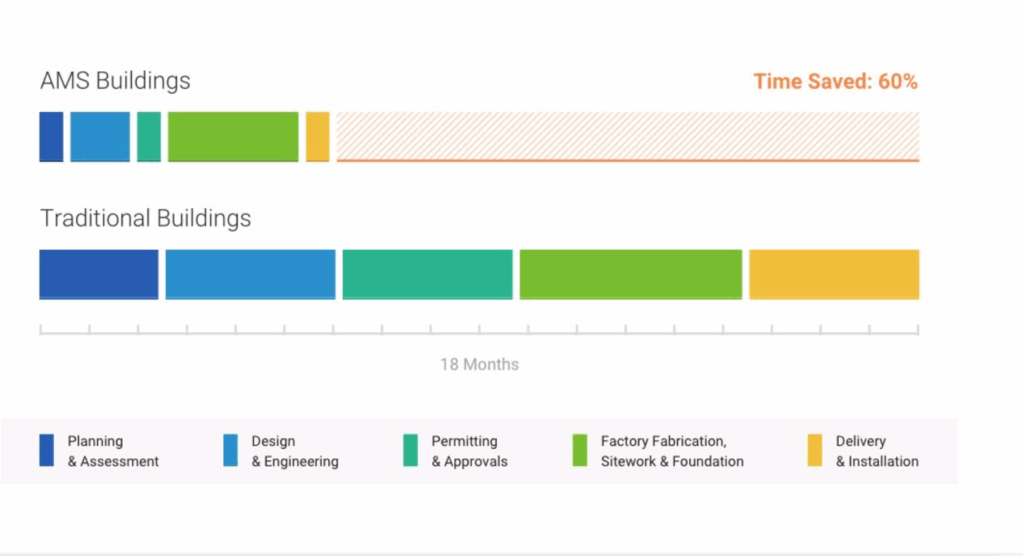
Conventional construction methods are inefficient, taking years to design and construct buildings that community colleges need now. Students’ immediate needs go unmet, and campus life is disrupted by onsite construction that interferes with classes and campus activities. Noise, air pollution and traffic increase, creating health and safety risks for college students who’re on campus day and night year-round.
How modular construction helps
Modular is the only way to add quality space rapidly. Building off-site allows modular manufacturers like AMS to deliver projects 60% faster than conventional construction. Building in a climate-controlled factory eliminates weather delays, and modules are delivered 95% complete and installed the same day. Districts are more agile, able to deliver both small- and large-scale projects on a shorter timeline.
- Add high quality buildings in as little as 60-90 days
- Build and install multiple buildings simultaneously
- Minimize on-campus disruption, noise and risk
- Expedite procurement with streamlined plan approval
Flexible Space at a Lower Cost
As learning becomes more flexible, learning spaces need to flex, too, supporting a variety of different programs and teaching methods in adaptable, future-proof environments. Community colleges looking to meet the needs of a diverse student body often find that needs exceed funds. With modular, districts can create dynamic designs on a limited budget, maximizing the value of every square foot.
How modular construction helps
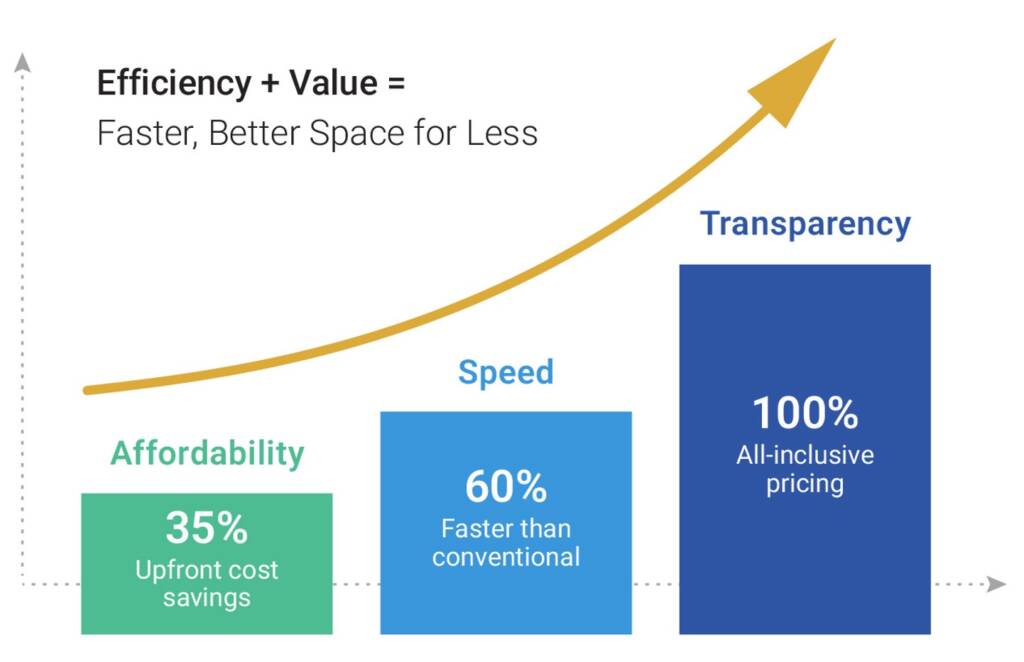
Modular’s ability to fast-track projects with greater cost predictability positions community colleges as construction-ready prospects for funding. Once a contract is in place, factory costs are fixed, assuring districts of on-budget, to-spec delivery with minimal change orders. AMS’ precision process saves money at every phase of production, delivering higher quality buildings for 35% less than conventional.
- Avoid surprises with transparent, all-inclusive pricing
- Value-engineer designs to add functionality and cost savings
- Make customization cost-effective with DSA-PC or PE designs
- Reduce labor and material costs with automated production
Healthy, Sustainable Design
California colleges are progressive, designing buildings that soften their environmental impact and provide a safer, healthier environment for students. Many community college districts are committed to lowering their carbon footprint with sustainable innovation, exploring energy alternatives, choosing natural materials and integrating sustainable technologies that pay back in lower operating costs.
How modular construction helps
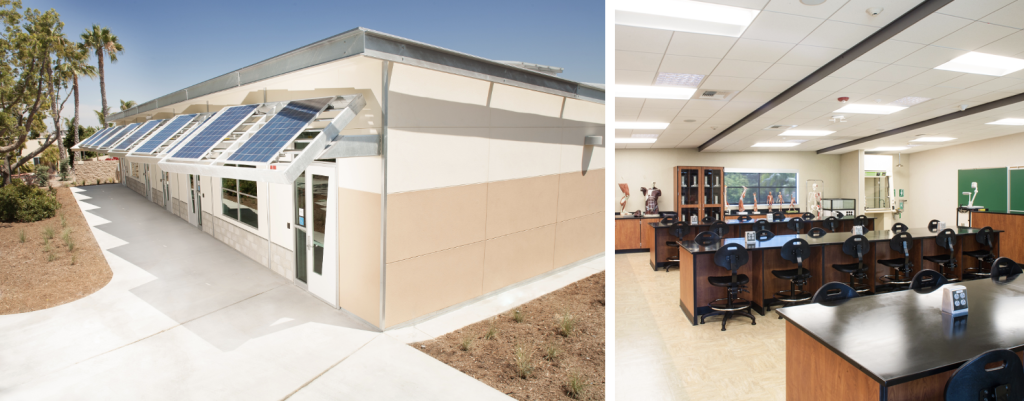
Efficient construction and transportation methods lower a modular building’s environmental footprint, making it more eco-friendly than a traditional building. Modular buildings are not only built more responsibly, they can be designed to achieve any level of LEED certification more economically. High-performance modular solutions like GEN7 make sustainability turnkey, optimizing both energy savings and student health.
- Divert 90% of construction waste from landfills
- Optimize resource allocation, stabilizing material and labor supply
- Decrease health and safety risks from dust, machinery and traffic
- Reduce drain and stress on the local infrastructure and ecosystem
Using Modular Design to Help Students Succeed and Thrive
Community colleges are becoming proactive in making the changes needed to attract and retain students in a competitive educational landscape.
Districts are modernizing career education to make students more job-ready, reconcepting learning spaces to align with new degree pathways and provide hands-on, tech-driven training in program-specific environments.
They’re expanding beyond academics, offering comprehensive support services and resources in auxiliary facilities that advance students’ personal, social and career development.
Whether they’re adding learning space or support space, districts have learned that better environments lead to better academic outcomes. And creating these environments starts with creating a better experience for the students who’ll use them.
Creating Student-Centered Spaces to Engage and Support
A community college campus is what its name implies: a community. Modular design makes it easy to create facilities that connect with students, instilling a sense of belonging in a diverse community.
Student-centered design is intentional. No matter what the space is used for, it creates an empowering environment where all students feel supported and accepted. Every detail is thoughtfully curated to appeal to students, inviting engagement and ensuring a positive experience in a space where individuals can thrive.
Students want more than a place to learn; they want spaces that are:
- Easily accessible
- Warm and welcoming
- Safe and secure
- Focused on their well-being
- Comfortable
- Inclusive
- Bright and modern
Creating Specialty Spaces Customed to Need
While student-centered spaces focus on making students feel welcome and supported, specialized spaces focus on meeting a specific set of needs. Unlike general classrooms, which are designed to multi-task, specialty spaces are designed to fulfill a certain purpose.
With modular design, districts can customize any space for any purpose, elevating functionality and aesthetics to fit specialized needs. Spaces can be configured and fitted out for vocational training or programming with specific requirements, like dance, music and art studios or science and media labs. Spaces can be optimized to consolidate resources or help students manage the demands of daily life.
Some popular types of specialty spaces include:
- Healthcare and Medical
- Kitchen and Concessions
- Laundry Facilities
- Libraries and Resource Centers
- Lobby and Office/Administration
- On-Campus Childcare
- Sports Facilities and Locker Rooms
- STEM Buildings
- Student Unions/Student Services
- Workout and Fitness Space
Virtually any design can be modularized, giving districts the option to add a single building, multiple buildings or a complete campus, built to their precise specifications. It’s a practical way to customize space to modernize campuses, grow enrollment and give students the resources to succeed.
Modular Innovation: Creating the Ideal Design for a Unique Project
Like many colleges, Allan Hancock College is modernizing its campuses to reflect the shifts in higher education—and using modular construction to do it. The college’s AMS Academic Success Center expanded support for MESA/STEM-based programming, but the district had a bigger vision: to offer a broader range of services to support students’ physical, social and emotional health and well-being.
The vision grew into Allan Hancock’s new Student Health Center, an innovative concept that aligns seamlessly with the college’s wellness culture.
Working with AMS and 19six Architects, the Allan Hancock Community College District was able to leverage advanced modular design capabilities and construction efficiencies to create a highly customized space that’s supportive of students, affordable for the district, adds value to the community and is responsive to the needs of all.
Here’s how we did it.
Matched design to need
The holistic design concept reflects the school’s commitment to wellness and the desire to create a vibrant campus that promotes the “whole student” experience. Starting with a pre-engineered AMS EVOLVE design allowed full customization, with every feature and finish tailored to the project goals and aesthetic. The design is purpose-driven and highly specialized, consolidating a variety of health and wellness services in a centralized on-campus hub that makes it convenient for students to get the help they need to lead a healthy, balanced life.
Optimized limited space
The site-specific design needed to fit a lot into a tight space on an active campus. The compact footprint efficiently blends public and private areas, housing state-of-the-art medical care, mental health counseling and nutritional support in one side of the building with a student food pantry, clothes closet and laundry room accessible via separate entry. Roof caps raise the roof to 21’ in key areas, allowing tall ceilings with motorized clerestory windows paired with storefront windows—custom features that visually expand the space, making it more inviting and energy-efficient.
Maintained a cohesive campus
The college had cultivated a distinct style that was important to maintain. The Student Health Center needed to be readily identifiable while blending in with the established campus aesthetic. A contemporary façade and neutral palette were dressed up with metal accents that mesh well with existing buildings, many conventionally built. Architectural red Mapes panels, metal window canopies and louvered overhangs are functionally aesthetic—style choices that increase thermal efficiency and sun control, keeping the interior comfortable and aligning with the district’s energy goals.
Maximized modular economies
While the building design addressed student needs, construction needed to meet the district’s schedule and budget, creating cutting-edge space quickly and cost-effectively. Building in the AMS factory kept on-campus noise and disruption to a minimum. Parallel construction allowed the modules to be fully assembled while the site was being cleared and prepared, expediting delivery of a sophisticated design. The building is exactly what the district envisioned—beautiful, functional, adaptable and sustainable, affordably meeting both immediate and future needs
Modular Building Solutions Help Community Colleges Succeed
An experienced partner like AMS simplifies the complexities of building on a busy campus, value-engineering designs and streamlining construction to deliver state-of-the-art facilities at the greatest time and cost savings.
We’re California’s most trusted modular school manufacturer, known for the quality of our work and the reliability of our buildings. We build the most because we offer the most.
- 43 years of experience in modular school construction
- Cost predictability with transparent, locked-in pricing
- Fastest speed to occupancy: as little as 30-60 days
- Design flexibility for all needs, programs and budgets
- Specialty spaces fully customizable to any need
- Scalable solutions for modular and hybrid concepts
- End-to-end support from pre-planning to post-delivery
Today’s students and community colleges don’t just want options—they want better ones. AMS provides them, giving districts a way to build the space students need faster and more affordably than ever before.
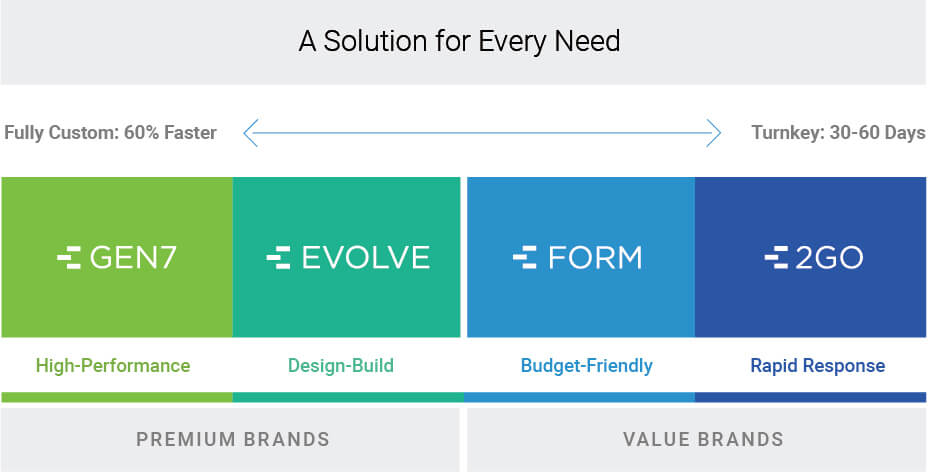
We offer four branded building solutions to get you started, with a range of options from turnkey to design-build.
See how much you can save — Request a Quote.